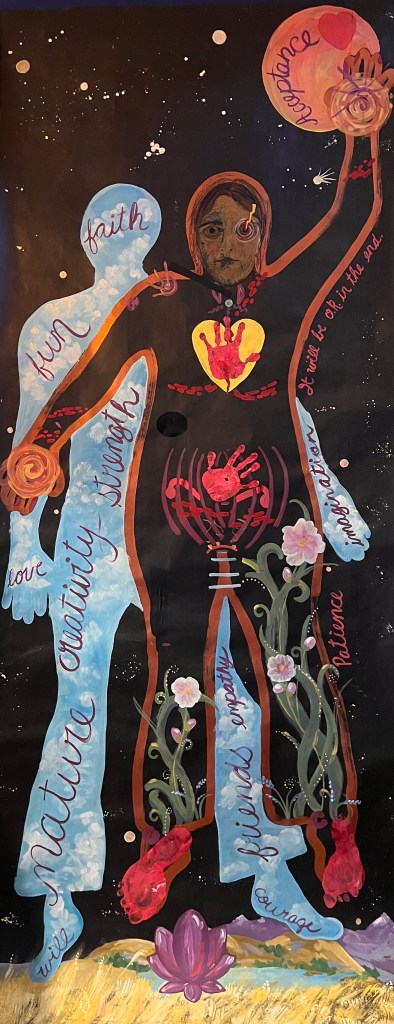
Becoming an art therapist brought together some of my favourite interests – art, writing, culture, and psychology – in an exploration of how creative expression helps us better understand why we do the things we do.
I am in awe when I witness how the creative process reveals unexpected insights to a participant that shift understanding and flow into change. My therapeutic approach is collaborative and holistic (mind, body, community, spirit) while focusing on the creative process to help you become more self-aware and identify strengths.
You are looking for positive change in your life, and that’s what brought you here. That was a big step. From here, I’ll walk alongside you with all the benefits art therapy brings to support and encourage you on your healing journey.
Art therapy graduate and graduate-level programs have what you might expect in mental health training such as counselling skills, psychology, mental health, human development, ethics, research, and supervised practicums. But the difference is that the art is more than tools in a tool box – the art is the therapy. The creative process is the foundation of the art therapy profession. Visit the Saskatchewan Art Therapists website to learn more about art therapy including training, practice requirements, professional organizations, a contact list of the over 25 art therapists in Saskatchewan.
I graduated in 2012 with honours from the Kutenai Art Therapy Institute (KATI) in Nelson, BC. There are nine graduate and graduate-level art therapy programs in Canada approved by the Canadian Art Therapy Association, but moving to Nelson to train and live in the Selkirk mountains was an adventure I couldn’t resist. After graduating, the prairies called me home.
After four years in private practice in Regina, SK, I moved back to British Columbia from 2017 to 2019 to deliver art therapy for Nisga’a Lisims Child and Family Services in Northern BC and Ki-Low-Na Friendship Society I’m honoured to have learned the importance of cultural safety and humility from the Indigenous communities in which I lived and worked and for being invited to participate in cultural practices. Then in 2020 I returned to the prairies, this time Saskatoon, where I live and once again have a private practice.
In addition to individual referrals, I’ve delivered groups for the following organizations in BC and Saskatchewan:
Schools: Balgonie Elementary School, Saskatoon Open Door Society, East Central First Nations Education Authority, Central Okanagan Public Schools Aboriginal Education (BC)
Youth Group Homes: Paper Crane Community Arts/Ranch Ehrlo, Eagle’s Nest Youth Ranch
Mental health: Canadian Mental Health Association Members Club, Foundry (BC), Bridges Counselling (BC), Cornerstone Shelter (BC), Saskatchewan Health Authority Mental Health and Addictions
Disabilities: Chip and Dale Homes, Cosmopolitan Industries, Creative Options Regina, Hope’s Home, Sask Abilities, Elmwood Residences, Light of the Prairies
Non-profits: Early Childhood Intervention Program, YWCA Kids in Transition, Boys and Girls Club (BC), OUT Saskatoon, the Refinery, Raising Hope, Sofia House


Professional Development and Training
- 2025/23/21 Canadian Children’s Grief Symposium
- 2022 The ASK Workshop: Assessing suicide in kids (2-day workshop)
- 2021 Addiction Studies Online Certificate, Mount Royal University
- 2020 ASIST, ABK Wellness Consulting (2-day workshop)
- 2019 Water Teachings, Okanagan Nation Alliance (1-day workshop)
- 2019 Strengthening Our Youth Workshop, Westbank First Nation (1-day workshop)
- 2018 8th International Research Conference Adults and Adolescents with FASD, UBC (3-day conference)
- 2018 Neurosequential Model of Therapy, Dr. Emily Wang, Hull Services (2-day workshop)
- 2017 Indigenous Tools for Living, Justice Institute: Aboriginal Focusing Oriented Therapy (3-day workshop)
- 2017 Vicarious Trauma: Prevention and Resilience Strategies, Thrive Training and Coaching (2-day training)
- 2015 Practical Tools for Helping Children, Crisis & Trauma Resource Institute Inc. (2-day workshop)
- Ongoing National Institute for the Clinical Application of Behavioral Medicine (NICABM) online: Why the Body Holds the Key to Trauma; How to Help Clients Overcome Anxiety-A Mindful Approach; Rethinking Trauma; How to Work with Shame, Practical Skills for Working with a Client’s Anger; Treating Trauma Master Series
 Dianne Shannon Art Therapy